
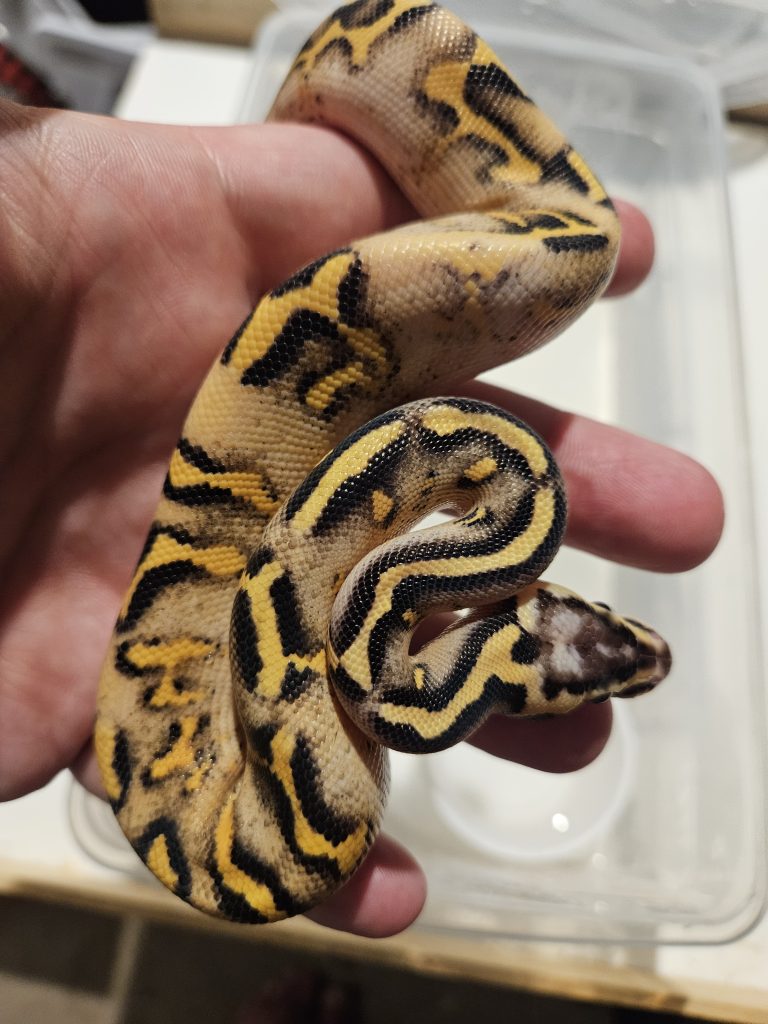
Ball Python
Python regius
Overview
Congratulations on your new pet!
Haunted Hatchlings has compiled a care guide to help you get started as a ball python keeper. We have consulted a variety of sources for information, but we encourage you to do further research as best practices evolve over time. There are many ways of keeping pets…what’s most important is that your new snake continues to grow and thrive!
Adult male ball pythons are generally smaller than females, growing between 2-3 feet in size. Females are typically heavier and typically average 3-5 feet long. Ball pythons in captivity can live 15-30 years. This species is known for being shy and docile. They are crepuscular, which means that they are mostly active at night, particularly close to dusk and dawn. Ball pythons are one of the most popular species of pet reptiles and come in a variety of morphs (colors and patterns).
Basic Care
Ball pythons require a temperature gradient within their habitat and should have access to a warm hide and a cool hide. You can use a thermometer/hygrometer to monitor the temperatures and humidity within the enclosure.
-
Warm hide temperature: 86-90°F (30-32°C)
-
Cool hide temperature: 72-80°F (22-27°C)
-
Nighttime temperature: 70-78°F (21-26°C)
Ball pythons require adequate humidity in order to shed properly and maintain respiratory health. Proper humidity should be between 60-80%.
Tips for increasing humidity
-
Dampen substrate with water and mix it around with your hands
-
Pour water into the corners of the enclosure and mix the substrate around (do NOT rely on misting-the moisture will evaporate too quickly and will not help increase humidity long-term)
-
If you have a screen/mesh top enclosure, use HVAC tape to cover the majority of the screen/mesh
-
Add a humid hide to your enclosure. Simply line a hide with dampened sphagnum moss. If doing this, make sure to change the moss out regularly to avoid mold growth.
-
Build a bioactive enclosure-a bioactive enclosure requires more time and effort to setup, but it can make maintaining higher humidity levels easier. If you’re interested in building a bioactive setup, please refer to our Bioactive Setup Guide.
Setup
Enclosure
Ball pythons can thrive in a variety of enclosure types, but the most common types are glass aquariums or glass or PVC front-opening reptile enclosures. We recommend starting young ball pythons in a 20-40 gallon enclosure to reduce stress, but you could start them in a larger enclosure with proper clutter and abundant hiding places. The recommendation for adult ball pythons is generally a front-opening 4x2x2 enclosure.
Heat Source
As with enclosures, there are multiple heat sources that you can use with your ball python. The most common ones are DHP, CHE, and heat mats. The recommended wattage type will vary depending on the type of enclosure.
Thermostat
Regardless of what type of heat source you decide to use, a thermostat is an absolute MUST. Failure to use a thermostat could lead to serious injury or even death of your reptile. We use a BN-Link thermostat that is available on Amazon.
Thermometer/Hygrometer
There are many choices when it comes to thermometers and hygrometers. AVOID anything that sticks to the enclosure as the adhesive can become stuck to your snake causing injury. Some thermometers have Bluetooth and/or WiFi capabilities so that you can check them remotely. For this reason, we prefer the Govee brand. The app allows you to set parameters for temperature and humidity and you will receive alerts whenever adjustments need to be made.
Substrate/Bedding
There are many substrate options available. We prefer a mix of organic cypress mulch (such as Forest Floor) and coconut chip (such as Reptichip). Coconut chip helps retain moisture, while cypress mulch can be a more affordable option. You can use either bedding on its own, just make sure to pay check the humidity regularly.
Hide(s)
Depending on the size of the enclosure, it should have at least 1-2 hides. A small starter enclosure may only have appropriate space for 1 hide, but a long-term enclosure should have 1 hide on the hot side and 1 hide on the cool side. Some snakes frequently move between hides, while others seem to prefer a specific hide and will spend most of their time there.
Water Dish
Your ball python should have access to a water dish at all times. The water dish should be large enough for the snake to fit into so it can soak if desired.
Enrichment
This part is where you can really make the enclosure your own! At minimum, we recommend some fake greenery for your ball python to hide behind and explore, but you can add other decor as desired. Some ball pythons will utilize large sticks or branches for climbing.
Kitchen Scale (OPTIONAL)
A kitchen scale is optional, but can prove to be a valuable tool. You can use a kitchen scale to help track your snake’s growth and to weigh feeders if you’re not comfortable estimating their size/weight in relation to the size of your snake.
NOTE***
Two things you will want to be mindful of are making sure to sanitize all decor before adding it to your enclosure AND to pay attention to any aspects of the decor that may harm your pet. AVOID anything with sharp edges and look out for holes that your pet may be able to fit into (they can and will fit into smaller spaces than you’d expect).
Extra Notes
Ball python’s personalities and temperament can vary depending on the individual, just like people. Some are more shy, others are defensive, and still others are naturally curious and friendly. Regardless of the individual personality, we recommend waiting to handle your new pet for 24-48 hours after its first successful feeding. We know that it can be hard to wait, but we’ve found that waiting greatly increases the likelihood that the snake will eat when prey is offered.
Once you’re ready to start handling your new snake, we recommend starting off slow with handling sessions of 5 minutes or less. When getting your snake out of the enclosure, you can use your hands to scoop it up from the side (not from above) or you can use a snake hook. Use a loose grip and allow your snake to explore around your hands and arms. Follow the cues from your snake and gradually increase handling sessions up to about 10-15 minutes a day (remember to avoid handling for 24-48 hours after feeding).